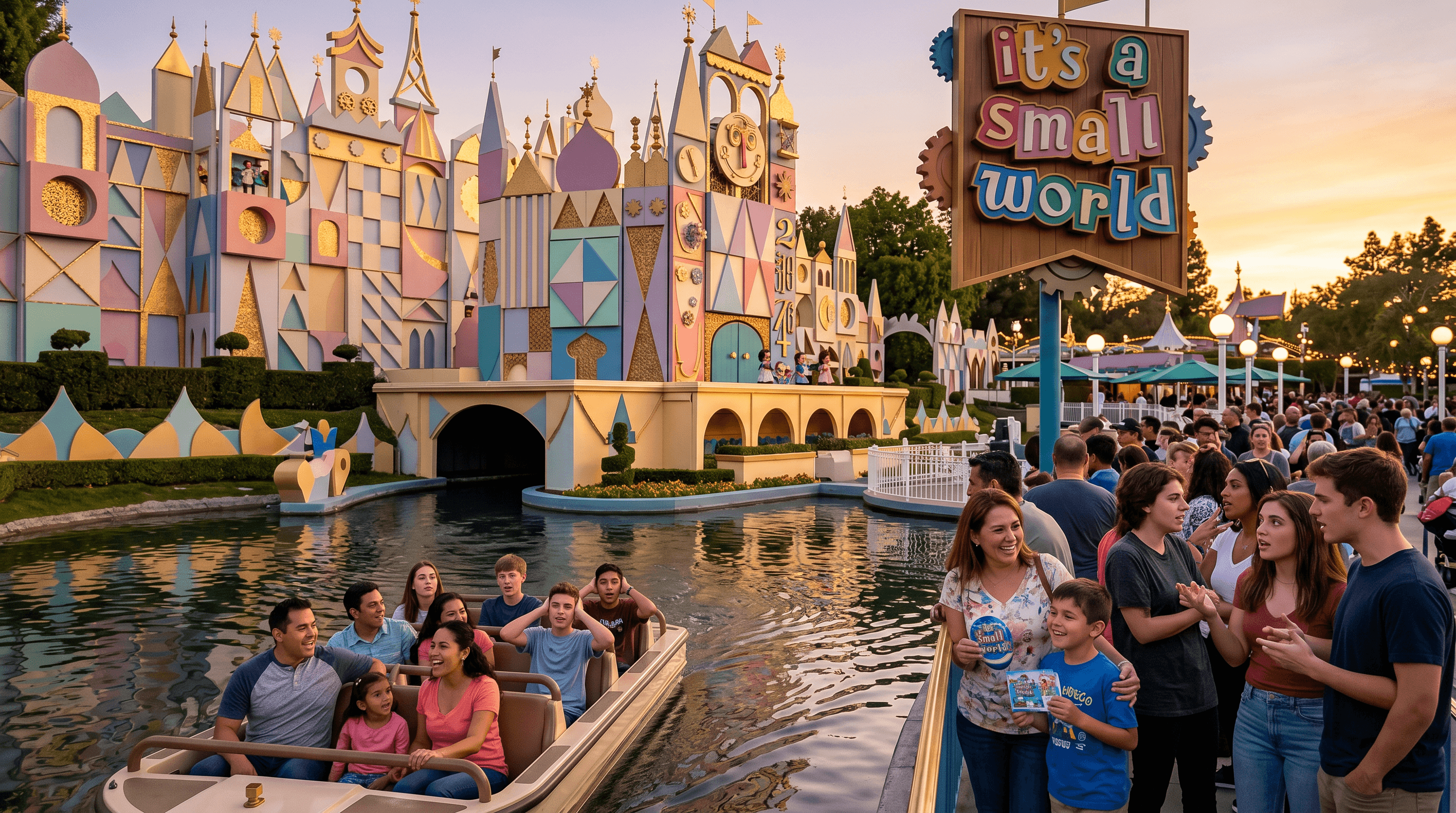

There's a moment — usually somewhere around the third or fourth chorus — when the song burrows so deep into your skull that you start to wonder if you'll ever truly leave. You're drifting past paper-mache children in national costumes, the colors are aggressively pastel, and everyone around you has either a beatific smile or the thousand-yard stare of someone who has been on this ride one too many times. That's the magic of it's a small world. And yes, I did use the word 'magic' unironically.
I've probably ridden this attraction fifty times across four different Disney parks. I've studied its history. I've interviewed people who teared up talking about it. And I still can't fully explain why it works — but it does.
Born at the World's Fair
The story starts in 1964, when Walt Disney himself commissioned the ride for the UNICEF pavilion at the New York World's Fair. The Sherman Brothers wrote that tune in about three days. Walt wanted something simple, repetitive, and universal — a melody that could layer different world music on top without losing itself. They nailed it so hard that the song is arguably more famous than the ride.
When the World's Fair closed, Disney brought the attraction to Disneyland in 1966, and it has lived in every major Disney park ever since — Magic Kingdom, Tokyo Disneyland, Disneyland Paris, Hong Kong Disneyland. It's the most geographically widespread Disney attraction in the world. That's not an accident. It's a flagship.
What Actually Makes It Special
Here's my honest take after covering this industry for fifteen years: it's a small world endures because it does something almost no other theme park attraction attempts anymore. It asks nothing of you.
There's no story to follow. No villain to defeat. No IP to recognize. You just... float. The sensory experience is deliberately gentle — bright colors, a lilting melody, cheerful motion. In a world where every new attraction is engineered to overwhelm, this one offers a kind of radical softness.
That said, the ride has evolved. Disney has quietly added characters from its animated films over the years — Ariel here, Woody and Jessie there — a decision that sparked genuine controversy among enthusiasts. I get the argument against it: the original vision was explicitly non-branded, a celebration of humanity rather than intellectual property. But I've also watched a five-year-old completely light up seeing Moana waving from a South Pacific tableau, and it's hard to call that wrong.
The Earworm Debate
Let's address the elephant in the boat. Yes, the song is relentless. Yes, it will follow you to the parking lot, through dinner, and into your dreams. This is not a flaw — it's an engineering achievement. The Sherman Brothers designed it as a round, meaning it sounds harmonious no matter where different audio zones overlap. Every version you hear as you pass through a new region is the same melody, different instrumentation. It's deceptively clever music.
People who say they hate the song are usually the same people humming it forty-five minutes later. I've seen it happen.
Still Relevant After 60 Years
With Epic Universe here and every major park racing to build bigger, faster, and more technologically sophisticated experiences, I think it's a small world becomes more valuable, not less. It's a palate cleanser. It's a rest for tired feet and overstimulated kids. It's proof that a great ride concept doesn't need a screen or a drop or a celebrity voice.
Some attractions age out. This one just keeps floating along, singing its song, completely unbothered by the roller coasters going up around it. And honestly? Good for it.